How to Manage Policies and Attestation: A Practical 8-Step Guide
A practical guide to managing policies and attestation: where organisations go wrong, what regulators expect and eight steps to get it right.

By John Ross | Corethix | October 2026
If you are responsible for your organisation's policies, you will probably recognise the problem. Policies are spread across shared drives and intranets, several versions of the same document are in circulation, review dates come and go, and when an issue arises nobody can say with any confidence who has read what.
Good policy management deals with the first part of that problem by keeping policies current, consistent and easy to find. Policy attestation deals with the second. It is the recorded confirmation that an employee, contractor or supplier has read and understood a particular version of a policy, and it gives you the evidence you need if a decision is ever questioned.
This guide looks at where organisations most often go wrong, what regulators and standards bodies expect, and eight practical steps for managing policies and attestation well.
In this article
- Why policies matter for managing conduct risk
- Where do organisations usually go wrong?
- What do regulators and standards bodies expect?
- Eight steps to manage policies and attestation
- Where declarations and speak-up channels fit
- Frequently asked questions
Why policies matter for managing conduct risk
Every organisation faces the risk that its people will do something that breaches the law or regulation, goes against the organisation's own values and policies, or falls short of what is accepted in its industry and the wider community. When that happens, the damage can be significant. It can lead to legal action against the company and its directors and managers, financial loss and harm to the brand, and it can take a real toll on staff welfare and morale.
Policies are how an organisation sets out the standards of behaviour it expects. They only work, though, if the content is up to date, people can find them and staff understand what is being asked of them. Without that, employees may simply not know what is, or is not, acceptable behaviour in the workplace.
Where do organisations usually go wrong?
The same problems come up again and again. Some organisations have never written integrity or conduct policies at all. Many more have them but have not kept them in line with current legislation or with where the business is heading.
Ownership is another common gap. When each department manages its own policies, they drift apart in tone, format and sometimes intent. Some are far too prescriptive, others are hard to follow, and version control becomes very difficult.
Access is a problem too. Intranets tend to collect old copies alongside current ones, so staff cannot be sure which version applies. Some organisations have no intranet at all, few offer access from a phone, and contractors and suppliers usually cannot get in.
Then there is the question of proof. Most organisations have no central way to confirm that staff have read a policy, let alone understood it, and no simple way to follow up with those who have not.
Imagine one of your employees breaches your code of conduct. When confronted, they say they were never asked to read the policy, or did not even know it existed. In many ways, that shifts responsibility for the employee's actions back onto your organisation.
Finally, policies often sit apart from the other tools that support good conduct, such as conflict of interest declarations, incident reporting and anonymous or whistleblower channels. Where these exist, they are frequently run in separate systems, so leaders never get a single view.
What do regulators and standards bodies expect?
Expectations have moved on. Regulators and standards bodies now want to see that policies have been communicated and understood, and they look for records that show it.
ISO 37301, the international standard for compliance management systems, requires organisations to plan what compliance information they communicate, to whom, how and when, and to make sure people are aware of the policies that apply to them (ISO, 2021). Standards Australia has adopted it locally as AS ISO 37301:2023 (Standards Australia, 2023). If you are working towards certification, you will need records to show this.
The US Department of Justice takes a similar line when it evaluates a company's compliance programme. Among other things, it asks whether policies are easy to access and search, whether the company tracks which policies employees actually open, and whether training is tested for effectiveness (US Department of Justice, 2024). Many multinational businesses use this guidance as a reference point, whether or not they operate in the United States.
The OECD's good practice guidance on internal controls, ethics and compliance also calls for regular communication and documented training at all levels of an organisation, and makes clear that it is intended for small and medium-sized businesses as well as large ones (OECD, 2010).
Australian law points the same way. Since December 2022, employers have had a positive duty under the Sex Discrimination Act 1984 to take reasonable and proportionate measures to eliminate workplace sexual harassment, and the Australian Human Rights Commission has been able to enforce it since December 2023. The Commission's guidelines expect organisations to develop, communicate and implement a policy on respectful behaviour, educate workers about it and review it regularly (Australian Human Rights Commission, 2023). Under the Corporations Act 2001, public companies, large proprietary companies and trustees of registrable superannuation entities must also have a whistleblower policy and make it available to their officers and employees (ASIC, 2019).
For Australian organisations, our page on policy management software in Australia explains how Corethix can help.
What these frameworks share is a focus on evidence. A policy that cannot be shown to have reached, and been understood by, the people it applies to offers little protection when something goes wrong.
Key takeaway
A policy that cannot be shown to have reached, and been understood by, the people it applies to offers little protection when something goes wrong.
Eight steps to manage policies and attestation
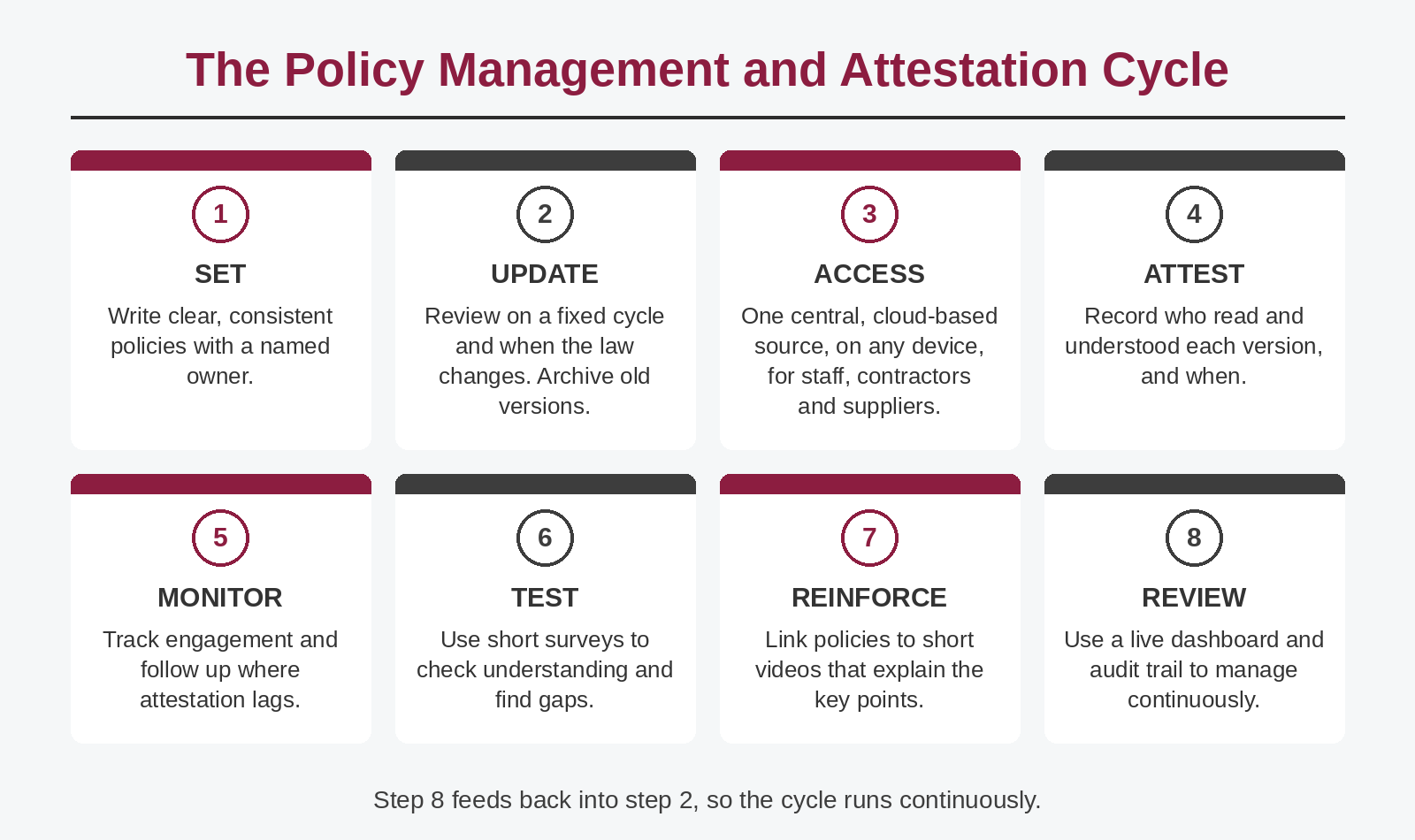
Managing policies well is an ongoing cycle. The steps below follow that cycle from drafting a policy through to checking that it is working.
1. Set clear, consistent policies
Your policies should spell out the standards of behaviour you expect from employees, contractors and suppliers. Use one template across the organisation, write in plain language and give every policy a named owner. Where you can, set out principles rather than trying to cover every scenario. Each policy then needs to be communicated to everyone it applies to, so they understand their role and responsibilities.
2. Keep them up to date
Give every policy a review date, and bring it forward when legislation, regulation or the organisation's strategy changes. The policy owner should be alerted well before the review is due, so there is time to update the policy and relaunch it for people to read and attest. Archive each outdated version rather than deleting it. If there is ever an investigation, you will need to show which version was in force at the time.
3. Make policies easy to access
Keep one current version of each policy in one central place. A cloud-based platform means employees, contractors and suppliers can reach policies from a PC, Mac, tablet or phone, including when they are away from the office. An internal intranet rarely manages this, especially for people outside the organisation.
4. Require attestation
When a new or updated policy is launched, tell everyone it applies to and give them a set period to read and attest to it. Record each person's attestation against the version and date, along with how they interacted with the document. This is the record you will rely on if you ever need to show that a policy reached the people it was meant for.
5. Monitor engagement and follow up
Present attestation data in a way that makes gaps obvious, for example by team, location or policy. Reminders and follow-up from managers can then go where they are needed. It is far easier to chase outstanding attestations as they arise than to discover the gaps in an annual report.
6. Test understanding
Attestation tells you that someone has read a policy. It does not tell you whether they understood it. Short surveys with a few questions on the relevant policies can reveal knowledge gaps and show where more training or clearer drafting is needed. Keep the results, so you have a record of understanding for each employee, contractor and supplier.
7. Reinforce with video
A short video covering the key points of a policy can help, particularly for complex or high-risk topics. Videos can be made in-house or sourced from external platforms. Some organisations use a video in place of a written policy for certain topics. If you do, track viewing and attestation in the same way you would for a document.
8. Review continuously
Bring the key information together in one place: policies due for review, attestation rates and survey results. A real-time dashboard makes it much easier to spot problems early, produce current reports and keep an audit trail. Linking this data to your risk register also connects policy compliance with your wider view of conduct risk. What you learn here then feeds into the next round of policy reviews.
Where declarations and speak-up channels fit
Attestation shows that people know the rules. They also need a safe and simple way to raise concerns when the rules may have been broken, or when their own interests could conflict with those of the organisation. In practice, that means having:
- conflict of interest declarations, managed centrally and overseen by the appropriate leaders
- workplace incident reporting, including health and safety matters, with a clear process for review and close-out
- a way to report behaviour anonymously when it may breach policy
- whistleblowing processes and protections, so concerns can be raised safely and securely.
Staff are more likely to use these channels if they can do so from any device and are confident they will be protected. Running them alongside your policies in one integrated system also gives leaders a single view of conduct risk across the organisation.
For the next stage of handling a report, read Investigating Conduct Incidents: From Report to Resolution.
Frequently asked questions
What is the difference between policy acknowledgement and policy attestation?
The two terms are often used interchangeably. Acknowledgement usually means a person has confirmed they received a policy. Attestation goes further, confirming that they have read and understood a specific version and agree to comply with it.
How often should policies be reviewed?
Most organisations review conduct and compliance policies at least once a year, and sooner if legislation, regulation or the business itself changes. Higher-risk policies may need more frequent review.
Should contractors and suppliers attest to our policies?
If they act on behalf of your organisation or work alongside your people, yes. Misconduct by a contractor or supplier can cause the same legal and reputational damage as misconduct by an employee, and international anti-corruption guidance, including the OECD's, expects compliance programmes to extend to business partners where appropriate.
What records should we keep to evidence attestation?
As a minimum, keep the policy version, its launch date and who it was sent to, the date each person attested, any knowledge test results, reminders and follow-up, and archived copies of earlier versions.
Is a signed attestation enough on its own?
It is good evidence that a policy was read, but weaker evidence that it was understood. Combining attestation with knowledge testing and regular monitoring puts you in a much stronger position.
Getting started
If your policies are currently spread across several systems, a sensible first step is to bring them into one place, confirm who owns each one and set a review date for each. Attestation, testing and monitoring can then be built on that foundation.
Corethix brings policy management, attestation, knowledge surveys, videos, declarations and incident reporting together in one cloud platform with real-time dashboards. If you would like to see how it could work for your organisation, book a demo with our team.