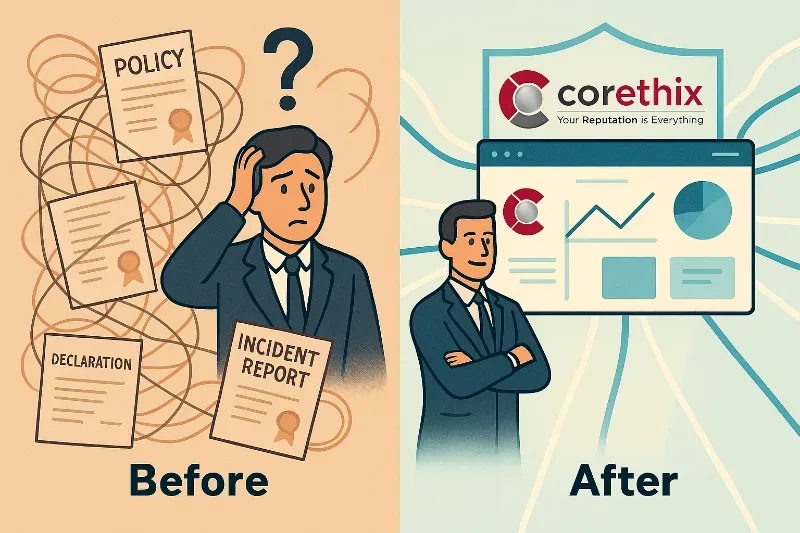
Employee conduct risk is the risk that staff behaviour falls short of an organisation's stated values, ethics, or regulatory obligations. Managing it well is what turns a stated culture into a real one — here's why it matters, and how to do it in practice.
In the modern corporate landscape, the significance of a healthy organisational culture cannot be under-estimated. A vibrant and inclusive culture doesn't just boost employee morale and engagement; it can be a powerful driver of sustained success for your organisation. One pivotal aspect of fostering such a culture is the proactive management of employee conduct risk, an area that is becoming increasingly complex to manage. This involves ensuring that employees' behaviours and actions align with the organisation's values, ethics, and regulatory standards. It's about bridging the gap between what we say we will do and what we actually do.
Managing employee conduct risk isn't merely a matter of compliance; it's an investment in the long-term vitality of your organisation. Here's why:
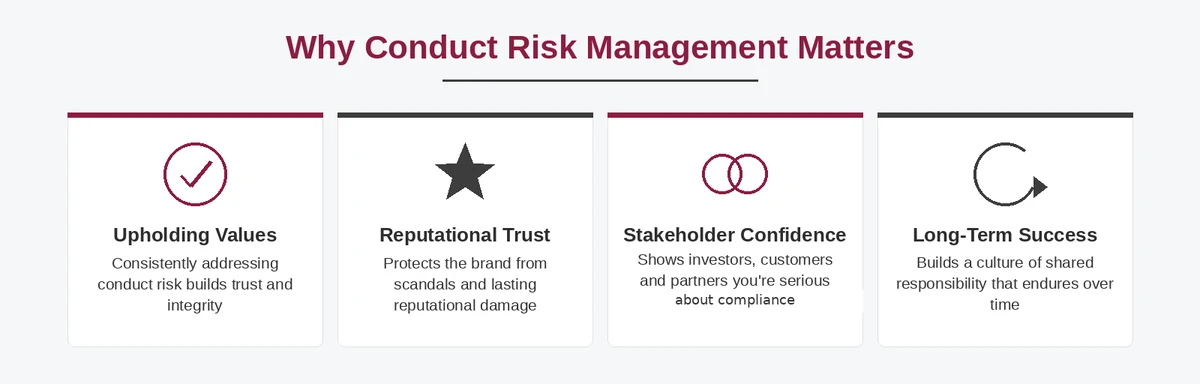
Why Does Conduct Risk Management Matter?
Upholding values. Organisational values are the bedrock of culture. By consistently addressing and managing conduct risk in a timely manner, companies demonstrate their commitment to these values, fostering a sense of trust and integrity among employees. When employees witness their peers and leaders upholding these values, and holding others in the organisation accountable, it inspires them to do the same.
Mitigating reputational damage. A single instance of unethical behaviour can tarnish a company's reputation irreparably. These days it's often not what actually went wrong that matters, it's how it was allowed to happen in the first place and how the organisation responds to ensure it doesn't happen again that matters. Effective conduct risk management ensures that employees' actions are in line with the organisation's ethical standards, reducing the chances of scandals or controversies that can damage public perception.
Boosting employee morale. When employees see that their organisation takes a strong stance against misconduct, it enhances their sense of pride in being associated with the company. This, in turn, improves job satisfaction and motivation, leading to increased productivity and reduced turnover rates. You only have to look at strong organisational cultures to see these common elements: happy and engaged employees, clear standards of behaviour that are upheld, a sense of community, and a willingness to get along and achieve the mission of the organisation.
Enhancing stakeholder confidence. Shareholders, customers, and partners value companies that prioritise ethical conduct. In today's business climate, this is an under-appreciated asset that companies should be investing in further as a way to set themselves apart from the competition. A robust conduct risk management strategy signals to stakeholders that the organisation is committed to sustainable and responsible business practices.
Attracting top talent. In today's competitive job market, prospective employees seek organisations with positive cultures and strong ethical values. A well-managed conduct risk strategy can serve as a powerful recruitment tool, helping the company attract and retain top talent. Attracting talent, as we all know, is only one half of the equation — retaining top talent is the other half, and a strong conduct risk strategy shows your people that you are prepared to "put your money where your mouth is."
Regulatory compliance. Compliance with industry regulations and laws is crucial for avoiding legal penalties. An organisation that takes employee conduct risk seriously is more likely to navigate regulatory challenges successfully, minimising legal and financial risks.
Fostering innovation. A culture that encourages open communication and accountability stimulates innovation. When employees feel safe to voice their ideas and concerns, it fuels creativity and problem-solving whilst building trust, contributing to the organisation's long-term growth.
Sustaining long-term success. Good businesses are built for the long run, and so is their culture — so it's vital to prioritise investment in your conduct, risk, and compliance programme. Effective conduct risk management nurtures a culture of shared responsibility and accountability that can weather challenges and change over time, ensuring the company's longevity.
In conclusion, managing employee conduct risk is an essential component of cultivating a robust and vibrant organisational culture. It goes beyond compliance, serving as a foundation for trust, reputation, employee engagement, and sustainable growth. By proactively addressing conduct risk, organisations lay the groundwork for a brighter future where ethics and values are at the forefront of their journey to excellence. Taking this step doesn't need to be overly complex or costly — there are now numerous tools, platforms, and software programmes that can help.
See how Corethix helps organisations turn these principles into a practical, everyday programme — explore the platform.
Is Conduct Risk an Issue for My Organisation?
All organisations are subject to the risk of their employees being involved in actions which are in breach of current legislative or regulatory obligations, contrary to the organisation's stated values, policies and objectives, or at odds with accepted standards and practices for their industry and the broader community. Such actions by employees can cause significant harm to a business, including potential legal action against the company and its management and directors, significant financial loss and damage to brand and reputation, and — importantly — harm to the welfare of employees and the morale of the organisation. To help protect against these risks, organisations need to ensure that they are compliant with their legal and regulatory obligations and have effective policies and procedures in place that align with the organisation's values, goals and objectives, and that employees understand and adhere to.
Every organisation, regardless of its size, industry or maturity, is exposed to conduct risks such as fraud, corruption, conflicts of interest and employee misconduct.
Key takeaway: Proactively managing conduct risk is the only way for an organisation to ensure that it is protecting its people, reputation, and bottom line.
How Do You Effectively Manage Conduct Risk? Best Practices to Follow
Commitment from the Board and Management
The successful launch and implementation of a people conduct risk programme involves many elements for organisations. For a start, there need to be up-to-date policies, procedures, registers and reporting tools in place. However, equally important, there also needs to be engagement from senior management, directors or business owners for employees to also become engaged.
The initial catalyst for a business to implement an integrity risk programme may in many ways have been based on evolving legislative requirements, changes in societal expectations, or even a specific conduct risk event occurring. However, before a business embarks on developing a conduct risk compliance programme, there also needs to be a clear decision by the management team and directors on the role that conduct risk compliance has in the long term for their business. This will also enable business leaders to more easily express to their whole organisation why integrity is important for everyone. In that way, the engagement of business leaders becomes the example for everyone in the business to follow.
Effective Policies and Procedures in Place
To help protect against conduct risks, it is critical for organisations to ensure they are compliant with their legal and regulatory obligations and have effective policies and procedures in place that align with their values, goals, and objectives. Organisations need to use policies and procedures to set out their expectations of standards and behaviour. These policies provide clear direction for employees, contractors and suppliers to operate under, and the organisation needs to enforce those standards of behaviour where required. The policies and procedures need to be clearly communicated to all relevant stakeholders within the organisation to ensure that employees understand their roles and responsibilities in adhering to them.
Keep Policies Up to Date
Conduct risk compliance policies need to be routinely reviewed and updated to ensure that they match the strategic direction of the organisation and current legislative requirements.
Ensure Policies Are Easily Accessible
All policies and procedures need to be easily accessed by employees, contractors and suppliers — otherwise, they may not be aware of what is, or is not, acceptable behaviour in the workplace. That means storing policies on an internal intranet can be a problem, as it doesn't allow contractors and suppliers access, and employees will have difficulty with mobile accessibility while away from the organisation. The best solution is a cloud-based software platform that provides access for all employees, contractors and suppliers, including access by mobile devices when away from the office.
Enforce Policy Attestation
Policy attestation refers to the process of verifying that employees, contractors and suppliers have read and understood the policies within an organisation. It helps ensure that policies are understood, implemented, and adhered to, thereby promoting a culture of compliance and risk mitigation. The best way to monitor policy attestation is to record all user interactions with policies and procedures and keep a record of each employee, contractor and supplier's acknowledgement of having read and understood them. It's also important to be able to easily review and analyse attestation records so there can be follow-up when attestation hasn't occurred.
Test Knowledge
In addition to monitoring policy attestation, testing users' knowledge of policies is an additional method to confirm that policies have been read and understood. This can be achieved by sending surveys to each user containing questions relating to their relevant policies, then analysing the results to identify any knowledge gaps. Survey results need to be recorded to document policy understanding for all employees, contractors and suppliers, for future review and detailed analysis.
Create a Register for All Declarations
Many organisations require employees to declare any actual or potential conflicts of interest that may arise, and to declare any gifts and entertainment they may receive. All declarations need to be recorded in a centralised register and managed with oversight by the appropriate leaders in the organisation. Approval of declarations should be recorded and date-stamped for review and future analysis (or investigation).
Provide an Easy Process for Incident Reporting (Including Anonymous Reporting)
All employees and contractors need a simple process to report incidents that occur in the workplace, such as health and safety issues or non-compliance with the organisation's policies and procedures. Nominated investigators need to be alerted when a new incident is reported and need the ability to invite others to assist with resolution. There needs to be two-way communication with the person who lodged the incident, so they are kept up to date with the progress of the investigation and informed when there's an agreed resolution. All incidents and investigation communication need to be recorded in a database to provide an audit trail for review, analysis and future investigations.
Many employees who want to report inappropriate incidents in the workplace would want to do so anonymously and want to be confident they will be protected as part of the reporting process. This requires access to a third-party reporting hotline and/or platform with full access 24 hours a day, 365 days a year. The focus needs to be on security and creating trusted conversations, as well as providing secure two-way communication with anonymous reporters. All reported incidents need to be stored in a database, providing indelible audit logs of all interactions.
Registration of Workplace Certificates
One of the more difficult areas of managing conduct risk is recording and monitoring workplace certificates. All organisations have some workplace certificate requirements for employees, contractors and even suppliers, and it's possible each person could have up to ten or more certificates required for their function, each expiring on a different date. The process of monitoring this is extremely difficult and time-consuming, and in most cases poorly done — yet the risk to the organisation of having uncertified employees or contractors is considerable. Effective monitoring requires all certificates to be uploaded by employees, contractors and suppliers and stored on a centralised database, allowing effective verification and oversight, and providing a warning if certificates are expired or not in place. Fortunately, there are software platforms that include this capability, with automatic email reminders when certifications are due for renewal.
Identify Potential Risks in Advance and Take Actions to Minimise the Potential Impacts
Risk is an inherent component of every organisation in the diverse business environment of the present day. All organisations, regardless of size or industry, can transform possible dangers into opportunities for growth by adopting a proactive risk management stance. Having a strong risk management framework is crucial for organisations to identify and evaluate potential risks, as well as develop effective strategies to minimise them.
A risk register is a useful tool to enable an organisation to record all identified risks, define the likelihood and consequences of a risk occurring, and to document actions being implemented to reduce the risks. It is a simple and effective way of identifying risks in advance and taking steps/actions to mitigate those risks.
Use Workflows to Bring Integrity to Your Important Business Processes
A workflow is a series of steps that are necessary to complete a task or process. It usually involves different stages, decisions, and participants, and can be used to ensure consistency and integrity in implementing and completing business processes.
Workflows can be created to efficiently complete often-repeated processes or can be quite complex for business processes requiring many steps and interaction from multiple team members.
Creating and implementing workflows provides an organisation with the ability to efficiently complete important business processes correctly and to ensure that all steps in the process are completed in the correct order.
Regular Review
The success of any programme to mitigate conduct risk requires regular review of all key elements, to proactively ensure compliance with policies and procedures and identify potential problem areas in advance. Details of policies checked for compliance, employees' attestation, survey results, conflict of interest and gift/entertainment declarations, and the status of incident reports should all be recorded and easily analysed.
Best practice is to have a real-time dashboard with analytics to measure the effectiveness of a conduct risk programme, providing proactive management, up-to-date reporting and an audit trail of historical data. This gives organisations a real-time view of employee engagement and the effectiveness of their conduct risk programme.
Frequently Asked Questions
What is employee conduct risk?
Employee conduct risk is the risk that staff actions or behaviours breach an organisation's values, policies, or legal and regulatory obligations — for example through misconduct, conflicts of interest, or unethical dealings with customers and colleagues.
How do I start a conduct risk management programme?
Start with visible commitment from the board and leadership, then put clear, accessible policies in place, track employee attestation, and build simple channels for incident and conflict-of-interest reporting.
Is conduct risk only a concern for large organisations?
No. Every organisation, regardless of size, industry or maturity, is exposed to conduct risks such as fraud, corruption, conflicts of interest and employee misconduct — smaller organisations often have less capacity to absorb the fallout.
How does conduct risk management improve organisational culture?
It demonstrates that stated values are actually enforced, which builds trust, boosts morale, and signals to employees, customers and investors that the organisation takes its commitments seriously.
What tools help manage conduct risk day to day?
Cloud-based platforms that handle policy attestation, conflict-of-interest declarations, incident reporting and workplace certificate tracking, with real-time dashboards to monitor overall programme effectiveness.
If you'd like help turning these best practices into a practical, proportionate conduct risk programme, Corethix can support you every step of the way.